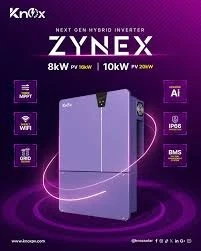

Based on what’s usually listed for the Zynex 10 kW hybrid inverter:
3 independent MPPT trackers — gives flexibility: you can connect multiple strings of solar panels (possibly with different orientations or roof segments), which helps maximize energy yield.
PV input (solar panels) capacity much higher than output — many listings show max PV array capacity up to ~ 20,000 Wp, or at least capable of PV oversizing (sometimes up to ~ 200% oversize) for better solar harvest and efficiency.
Battery + Grid + Solar hybrid support — compatible with lithium (LiFePO₄) or lead-acid batteries, giving you flexibility for backup or storage-based setup.
UPS-level switching (quick source switching) — many hybrid inverters can switch between solar/battery/grid quickly (often < 10 ms) so that during an outage or transition you don’t notice interruption.
IP66 dust & water resistance (for many models in this class) — meaning the inverter’s enclosure is dust-tight and resistant to water jets / splashes, so suitable for indoor or covered outdoor setup (important for Pakistan’s climate).
The multiple MPPTs help if your solar panel layout isn’t uniform (e.g. different roof angles, shading, orientations). This improves overall solar yield over simpler single-MPPT inverters.
High PV input capacity (oversizing) allows you to install more solar panels than the inverter’s rated output — good for maximizing generation, especially in sunny months or if you want to store surplus in batteries.
As a hybrid inverter, it gives flexibility to run on solar during day, battery (or solar + battery) during outages/night, and grid when needed — a robust backup solution for frequent load-shedding or unstable grid supply.
The 10 kW capacity means you can power a fairly big household with many appliances (fans, lights, fridge, TVs, maybe ACs depending on load) — or even a small business / office, with some planning.
IP66 (or similar) rating helps protect the inverter from dust, heat, occasional rain or humidity — which is practical given climate and environment in many Pakistani cities (dusty, hot summers, monsoon, etc.).
Panel array vs inverter specs: Make sure your solar panel array (number of panels, wattage, orientation, voltage, strings) matches the inverter’s MPPT and PV-input specifications. Oversizing PV beyond recommended limits can lead to inefficiencies or stress.
Load demand vs inverter capacity: 10 kW continuous is solid — but if you plan heavy loads (multiple AC units, heaters, motors, etc.) simultaneously, ensure wiring, breaker, load-distribution and surge protection are done properly.
Battery/battery-management setup (if using battery backup): Ensure battery type (LiFePO₄ or lead-acid), rating (voltage, capacity), and BMS (if needed) are compatible with inverter. Proper charging/discharging configuration matters.
Installation & environmental protection: Even with IP66 or dust/water rating — installation should be in a ventilated, shade-protected, well-earthed area. Also ensure regular maintenance (especially in dusty/hot environments) for longevity.
After-sales support, spare parts availability, warranty, and installer experience — especially important in cities outside major metro areas. Always check that local service is available near your area.
You should consider this inverter if you:
Have a large house or villa, or small business / shop / office — needing reliable power for multiple appliances.
Want a solar + grid + battery hybrid system — with flexibility for future upgrades or battery installation.
Want good solar yield — maybe you want to oversize PV panels or have complicated roof layout (different angles, shading, etc.).
Live in environment with dust / heat / potential water exposure — where inverter durability and protection matter.
Plan for backup during load-shedding or unreliable grid — and need stable, uninterrupted supply for essential appliances.

No review given yet!
 Fast Delivery all across the country
 Safe Payment
 7 Days Return Policy
 100% Authentic Products






You need to Sign in to view this feature

This address will be removed from this list
 english